Home  Sail Transport Stories Sail Transport Stories
Sail Transport Network Stories
|
by Jan Lundberg
|
 Sail-transport labelled
1) Thank the gods and goddesses of Mt. Olympus that it's over with;
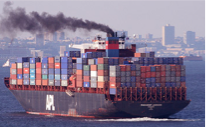
2) We feel even more insignificant as shippers using sails for propulsion after seeing large petroleum-belching cargo ships "sail" by with their massive economies-of-scale loads;
3) We are itching to do it all again, with a larger capacity sailboat and encompassing more islands and their products.
|
|
|
by Jan Lundberg
|
 Announcing: Aegean Cargo Sailing (SAIL MED) Announcing: Aegean Cargo Sailing (SAIL MED)
• Food security • Local development
• The Blue Economy • Healthy Seas
In a fast-changing world, it is no longer possible to automatically assume that what one is used to will endure. People want stability and predictability, but, as they say, good luck with that. We are witnessing out-of-control evolution of a rapid, uncertain sort. Fortunately, there are pro-active initiatives that have seized the imagination of thinking people who think of the Earth as a community to share. They look ahead in terms of decades and even centuries instead of mere days or quarterly periods. |
|
|
by charlene Caprio
|
 Publisher's note: the following is our position summary available at the current United Nations climate meeting in Marrakech, prepared by Charlene Caprio. Publisher's note: the following is our position summary available at the current United Nations climate meeting in Marrakech, prepared by Charlene Caprio.
Since the UN climate meeting in 1997 in Kyoto, the International Maritime Organization (IMO) eagerly took on the responsibility to reduce shipping’s GHG emissions. The Paris Agreement further kept the IMO in control of maritime GHG emissions, rather than incorporating them into state obligations. Now, we see a continual let down by the IMO going into the UNFCCC COP22 discussions in Marrakech, Morocco. |
|
|
by Charlene Caprio
|
 Note: This report is Article #1 in our new Responsible Shipping Series. Author: Charlene Caprio
Transport by sea carries about 90% of the world's trade. Consumerism is fueled by vast choices; sometimes very selfish ones. Smugglers often push not just inanimate contraband, but also wildlife (flora and fauna) in whole or in their parts by sea transit. As our readers also know, today's dirty bunker fuel-powered cargo ships are able to supply massive cargo capacity due in part by a web of oil subsidies and lax regulations concerning pollution of the air and seas, as well as “flags of convenience" loopholes.
But illegal trafficking of wildlife, and shipping as a transit source for the trafficking, is starting to get the attention it needs. |
|
|
by Jan Lundberg
|
This article is being completed for graphics.
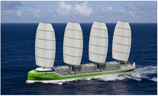 Eight Sail Transport Investment Projects, Spring 2016 Eight Sail Transport Investment Projects, Spring 2016
Publisher's note: this document has been published since March 2016 on the www.SAILMED.org website
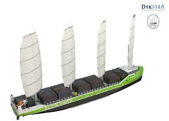
Our office receives numerous inquiries relating to possibilities for cargo-sailing opportunities. These inquiries range from crewing, starting a new project, and investing in existing projects. This document serves to summarize projects that welcome support through dissemination. No doubt this list, now of eight, will continue to grow. The cumulative effect of the trend will be to decrease today’s massive, questionable dependence on dirty petroleum fuels for shipping, and improve nations’ and regions’ socioeconomic resilience. |
|
|
by Jan Lundberg
|
 Oil-Dependent Maritime Shipping Is Achilles Heel in Hoped-for Renewable Energy Economy Oil-Dependent Maritime Shipping Is Achilles Heel in Hoped-for Renewable Energy Economy
Here is good news and bad news for getting your cherished consumer goods shipped across the seas. Hadn’t thought much about it? Have you thought about the oil-dependent ships’ pollution and their readiness to switch to clean renewable energy? Well, they’re not ready, and even if they could be, they don't want to be.
Good news: by now you may have heard of the revival of sail transport for what is now a niche market of delivering near-zero-carbon goods. |
|
|
by Jan Lundberg
|
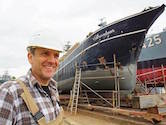
My report and photo shoot from Germany last month after attending the Paris COP21 climate meeting:
Elsfleth, Germany, near the North Sea - This is the Timbercoast project, renovating the Avontuur that was built in the Netherlands in 1920.
I found that she is speeding on to re-launch, with much work being efficiently done. She will be the biggest sail transporter on the planet, with a 70-ton capacity ( = 3 twenty-foot containers). This 44-meter (length from tip of bowsprit to stern) schooner is getting a complete remake. This vessel was looking good to me from my visits to the holds and from observing the work on board and in the ship yard. |
|
|
by Jan Lundberg
|
 Frgn. Minister, Marshall Is.
The Paris agreement is essentially a promise to make real promises later.
It is a positive development that the nations of the world agree to try harder (later, as promised). One key improvement over past Conferences of the Parties (COP) is that China (a so-called Developing Nation, even though it is the top emitter) has finally been joined with the U.S. and other Developed Nations, as to taking responsibility.
|
|
|
by Charlene Caprio
|
|
[Note: this article was written by Charlene Caprio, Policy and Strategy Consultant for STN/SAIL
MED.]
The UN Climate Conference in Paris (COP21) is well underway with positive momentum to adopt a new climate change agreement. The draft Paris agreement calls for parties to keep the global temperature well below 2°C (or below 1.5°C if this language is chosen) above pre-industrial levels. Each party shows how it will do its part by submitting an Intended Nationally Determined Contribution (INDC); 186 parties are represented so far in INDCs. Unfortunately, though, the INDCs fall short of getting us even to 2 °C.
Maritime shipping emissions must be part of the global solution. |
|
|
by Jan Lundberg
|
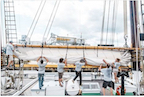 Last month the traditional schooner, Adventure, sailed from Portland, Maine to Boston with 11 tons of local products. It has been many decades since a concerted sail-transport feat like this happened on the New England coast.
Maine Sail Freight is the first significant sail-transport project in two years in the uncrowded sail-transport scene in the U.S. This is still the story of how Northern Europe, with EU support, is running rings around North America in terms of sailing cargo and R&D. There is a new industry for the post-peak oil and greenhouse world, holding much promise for growth. So, one would think the U.S. must not miss the boat. |
|
|
by Jan Lundberg
|
 Pico, Azores
Another successful round-trip voyage from The Netherlands to the Caribbean is coming to a close. The star example of zero-carbon shipping, the 32-meter brigantine Tres Hombres cargo sailing ship has made good progress across the Atlantic, and has left the Azores going northeast. |
|
|
by Jan Lundberg
|
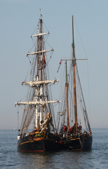 Under Captain Arjen van der Veen, the engineless 32-meter schooner brig Tres Hombres is arriving now in La Palma, Canary Islands. This is her sixth annual voyage across the Atlantic and back to Europe, carrying intensely desirable cargoes for discerning eco-savvy customers.
The tall ship started her voyage from her home port of Den Helder on Oct. 9. She first sailed to Stavanger, Norway to pick up a load of salt fish. From there she sailed to Brixham, UK, where she took on ale. Foul weather did not slow the ride; it made it faster. |
|
| | << Start < Prev 1 . 2 . 3 . 4 . Next > End >>
| | Results 1 - 22 of 70 |
|
|
|




