No Offshore Oil Drilling: Committee Against Oil Exploration (CAOE)
by Culture Change
03 April 2010
As part of our critique of the oil and car culture, to help bring on sustainable living, Culture Change has relaunched the campaign to help stop offshore oil drilling and protect ecosystems. The Committee Against Oil Exploration (CAOE: "K-O") works to connect ourselves (and you) to frontline grassroots groups everywhere working to stop new exploration for petroleum.
President Obama's recent announcement to open Eastern coastal areas to offshore oil drilling is a shock to many. Most of us have heard that the Arctic National Wildlife Refuge, thought to be the U.S.'s grand hope for massive new oil, has been protected—for now. (It would provide less than a year's worth of
driving for the U.S. vehicle fleet.) Other parts of the country are still threatened, and grassroots groups need help in places such as the Rocky Mountain area. With lessened
environmental regulation as industry's payoff after installing corporate collaborators in government, maximum petroleum exploitation is sought everywhere possible.
Culture Change is taking the nation's disastrous energy waste head on, with our Committee Against Oil Exploration, to wean our society off diminishing, unreliable supplies that just add to global warming, road slaughter, and more.
CAOE seeks to protect sensitive ecosystems from oil pollution and promote maximum conservation to curb dependence on all fossil fuels. If people did not buy so much oil or so many new vehicles, the economy would be rapidly transformed, albeit with serious adjustment difficulties due to the economy's hypersensitivity to the car and related industries. Yet, we must make the transition to a sustainable society the best we can, in hopes of minimizing damage to the Earth and ourselves. Some of us see cultural change, such as no more new oil drilling, as integral and inevitable. Oil dependence will end, as weird as that appears to corporate interests, as part of creating a sustainable society.
"U.S. seaports are the largest and most poorly regulated sources of urban pollution in the country." -- NRDC, Harboring Pollution
Background and Vision
Oil and natural gas are so dominant and subsidized that alternative solutions seem out of reach. Change happens whether we are ready or not. Global oil production is peaking right about now; the downslope means that growth for the world corporate economy is directly threatened.
Everyone must get ready for sustainable alternatives to survive oil scarcity. Isn't it time
for a cap on much of the greenhouse gases, such as from offshore oil drilling as a form of fossil fuel combustion? It's time to make it happen. One reason is that technofixes for a huge, green consumer economy are not truly sustainable, even if they were ready now. Meanwhile their assumed arrival puts off serious and overdue cuts in energy waste today. We will incorporate slashing energy use now with our efforts to stop the exploitation of oil fields that should be off limits forever. Help bring this about by linking together with us.
Most Americans agree it’s time to protect the environment and stop giving out more corporate welfare to the polluting energy companies. Offshore oil drilling and development of the East Coast and the sensitive Arctic National Wildlife Refuge (ANWR) are questionable supply-bandaids to try delaying the inevitable post-peak oil collapse by a few years. Local-based groups are understaffed and underfunded for this daunting task in their threatened areas. Our attention to their struggles is a significant way to help galvanize support.
The Case against Offshore Oil
(compiled by Rainforest Action Network, courtesy Mendocino Environmental Center)
A steady stream of pollution from offshore rigs causes a wide range of health and reproductive problems for fish and other marine life.
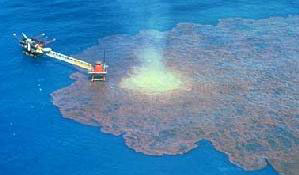
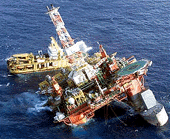
Offshore drilling exposes wildlife to the threat of oil spills that would devastate their populations.
Offshore drilling activities destroy kelp beds, reefs and coastal wetlands.
Over its lifetime, a single oil rig can:
Dump more than 90,000 metric tons of drilling fluid and metal cuttings into the ocean;
Drill between 50-100 wells, each dumping 25,000 pounds of toxic metals, such as lead, chromium and mercury, and potent carcinogens like toluene, benzene, and xylene into the ocean, and
Pollute the air as much as 7,000 cars driving 50 miles a day.
History of accidents and violations
In May 1992, Chevron USA pleaded guilty to 65 violations of the Clean Water Act and paid $8 million in fines for illegal discharges from the company's production platform of the California coast.
In March 1997, Chevron was fined 1.2 million for operating a well off the coast of Ventura with a broken ant-blowout valve, a key environmental protection on an offshore oil well.
In 1998, a rupture in Torch Oil's pipeline spilled 21,000 gallons of oil, damaging a rich ocean fishing ground and killing wildlife in the delicate coastal ecosystem at the mouth of the Santa Ynez River.
State and local authorities repeatedly cited the Venoco Corporation for releases of deadly hydrogen sulfide gas at its Goleta platform in 1998-99.
An ARCO pipeline ruptured in the 1994 Northridge earthquake, spilling 193,000 gallons of oil into the Santa Clara River.
Global oil extraction history
Since 1859, 800 billion barrels of oil have been burned worldwide.
The oil industry spends approximately $150 billion annually to search for new drilling sites.
There is an ecological limit to the use of oil: scientists warn of serious global warming as we continue to burn more and more oil.
Since 1988, the oil industry has drilled more than 100,000 exploratory wells, threatening frontier forests in 22 countries, coral reefs in 38 countries, mangrove swamps in 46 countries, indigenous people on six continents, and global climate stability worldwide.
"Oil in ANWR is scattered in many separate pools, so drilling rigs would be spread all across the coastal plain. The roads linking those rigs aren't part of the 2,000 acres: they're not "production and support facilities." -- Paul Krugman, New York Times op-ed March 1, 2002, shattering the Bush/oil industry myth that the Arctic National Wildlife Refuge would only impact 2,000 acres.
To become part of CAOE, email or write to us at
This e-mail address is being protected from spam bots, you need JavaScript enabled to view it
, or send mail to P.O. Box 4347, Arcata, CA 95518 USA. The Committee Against Oil Exploration already has some strategy in motion to link up grassroots groups and give them broader support.
Also, support the campaign for the "No Action" alternative in the government’s current proposal to allow oil and gas lease sales in Alaskan and Gulf outer continental shelf areas from 2002-2007. Send a letter to President Obama and your Congressional Representatives and tell them you are one more citizen against new offshore oil drilling.
World Oil Reduction for the Gulf is a longer-term approach to deal with catastrophic oil spills. WORG is the Culture Change-led coalition formed to respond to the BP-Macondo well blow-out in the Gulf of Mexico in 2010.
Culture Change mailing address: P.O. Box 3387, Santa Cruz, California, 95063, USA, Telephone 1-215-243-3144 (and fax). Culture Change was founded by Sustainable Energy Institute (formerly Fossil Fuels Policy Action), a nonprofit organization.
Some articles are published under Title 17 U.S.C. Section 107. See Fair Use Notice for more information.





 As part of our critique of the oil and car culture, to help bring on sustainable living, Culture Change has relaunched the campaign to help stop offshore oil drilling and protect ecosystems. The Committee Against Oil Exploration (CAOE: "K-O") works to connect ourselves (and you) to frontline grassroots groups everywhere working to stop new exploration for petroleum.

 (compiled by Rainforest Action Network, courtesy Mendocino Environmental Center)


