|
Culture
Change Letter
Culture Change through music! The Depavers eco-rock!
Overpopulation
has become a reality. Overpopulation
Resources and News Tidbits |


Culture Change e-Letter
#44
Overpopulation's toll
Water privatization
and the rising conflict
by Jan Lundberg
Your water is being stolen from you. The latest, greatest crime is called privatization. That people already have to pay for water through a utility seems outrageous, if we stop and question it: To look at waste in tax revenue, water could and should be free of charge. But in the U.S., for example, hundreds of billions of dollars are wasted in such time-honored programs as building new roads, making more weaponry, and chasing terrorists in the wrong places.
People accept such a screwing from government and its cronies just, in part, to be patriotic and go with the mainstream. But even those who have observed trends critically find it is shocking that among our rights that are diminishing, we are losing an assured supply of water. If we are rich, we don't have to be concerned. But over nine out of ten of us have to start worrying and taking action. It's part of the war of the rich against the poor.
Also during these modern times, pollution of our water has increased to the point that in countless cities, a person had better be able to afford a water filter or bottled water. Many of us are long since dispossessed of our birthrights as human beings. Didn't you grow up thinking ample, clean water was a right? Our masters wish us to revise that notion. Because of so many similar developments in the overall trend of corporate hegemony, the recent Culture Change Letter on nanotechnology stated as its title, "They're coming for you." Will you defend your land and water, or are most of the elements of life mere abstractions thanks to consumerism?
No one has a right to own the water. But this is what is well underway. Privatization used to mean that a government's transit department, for instance, would be taken over by a company that supposedly runs things more efficiently. Now, water supplies and water delivery systems are bought and sold by extremely large corporations that are often beyond any nation's laws. Their handmaidens are governments, banks, and others.
"Water, say the World Bank and the United Nations, is a 'human need,' not a 'human right.'... A human need can be supplied in many ways, especially by those with money. No one can sell or trade a human right." - Maude Barlow, co-author of Blue Gold: The Fight to Stop Corporate Theft of the World's Water.
Clean fresh water has been becoming scarce due to overpopulation for several decades. It is also true that waste and greed are creating artificial shortages of water, as happens with food. But, behavior resulting in injustice is a symptom of overpopulation and is aggravated by population growth. One sad result of greed, waste, and overpopulation is that mismanagement and skewed priorities deprive over one billion people of access to clean fresh water. More than twice that have poor sanitation for the same reasons (source: International Rivers Network).
Water privatization turns out to be the corporate agenda of the World Bank, the World Water Council, and other globalization players. Their strategy is to speak of shortage and take advantage of it whether it is manufactured or not. Their answer is to build infrastructure oh so profitably. They want to double this kind of spending to $180 billion a year.
If the economy remains intact in the next two or three decades, between half and two-thirds of humanity are forecast to be living with severe freshwater shortages. As the world is clearly running out of clean water, the solution, according to many governments and powerful corporations as well as international development banks, is to privatize water and let the market determine price and availability.
Critique of social justice tilt
While "Their" skullduggery is
abhorrent and must be fought, we have a bigger picture to keep in view.
The bottom line is that Population Growth + Climate Change = Exponential Water
Crisis. It seems that activists and foundations are seldom concerned with
all three parts of the equation, nor are
they able to connect the elements successfully for the public's consumption.
It is pointless to demand justice
for all thirsty people if we do not consider (1) how many of us are demanding
water and (2) what other species are being affected by our ongoing
demands. The world's people can cut water use equitably as a model for
the universe, but if they don't cut their numbers, according to logic,
eventually all is lost. That said,
we can look at details of the economic and ecological crisis that so few
observers tie to overpopulation. For example, water essential for growing
the population is pumped via nonrenewable energy, in the main (pardon
the pun).
Pumping water is almost always a petroleum exercise which means adding to greenhouse gas emissions. Petroleum-oriented agriculture wastes vast amounts of water, especially when devoted to growing beef. But just having running water (even just cold) for households is never questioned on ecological grounds despite how many people are engaging in this unsustainable activity because there are so many rationalizations. One chic rationalization for environmentalists running their taps and warming the globe is that driving a car is so much worse.
Because piecemeal reforms are not enough, what's needed is to reject the entire culture of materialism and technological excess. It is too late for reforms, due to so many years of greed satisfied by violence. At best, the mass media and almost all the alternative press offer the limited vision of reformers who have no answers for the big picture. Activists are also understandably distracted by various battles and brushfires.
Two of the more high-profile activists on the world water-rights crisis, Maude Barlow and Vandana Shiva, seem to slough off one of the obvious culprits in this crisis which is: overpopulation. Recently in Resurgence magazine, Barlow calls for "good governance" as the answer. What about stabilizing and eventually reducing human population? Ms. Shiva assumes that "[t]he culture of conservation of these 'common' rights has supported human life and all life on Earth for millennia." Actually, it was a low population size and little technological 'progress' that were bigger factors.
Brushfires versus hope
A case study or two seems to always fit into a pattern when commodification and greed are involved in "investment."
In Bolivia, the giant U.S. engineering
corporation, Bechtel, took over the water system. Rates were hiked and
protests mounted violently. The company was thrown out of the country
because the citizens were thrown up against the wall and did not intend to die
of thirst or see their crops shrivel and die. However, Bolivia's water
privatization incident is not rare; it is part of an escalating trend.
Or look at Africa:
"Every day 30,000 children in the Third World die of preventable causes. Many of them could be saved if they had access to safe water. The World Bank argues that governments in impoverished countries have to privatize their water supply and distribution systems if they are to get the efficient delivery of water that is needed.
"On the face of it, the argument makes sense. The adequate supply of water and other public services is too often frustrated by inadequate funding, inefficient bureaucracy or lack of political will. Promoters of private ownership say it brings investment and cost-effective service.
"Experience and common sense say otherwise. Private investors aren't attracted by poor and rural communities. Any improvements that might come with private ownership are in areas that generate profit. Private water, telecommunications and electricity companies tend to focus on efficiency in collecting tariffs, but not on improving service. Costs usually leap up quickly, annoying middle class and wealthy customers but leaving the poor without service at all.
"According to the Congress of South Africa Trade Unions, privatization has cost 200,000 people their jobs. In poor Soweto neighborhoods, up to 20,000 homes a month are disconnected from electric service for nonpayment." - by Wole Akande of Yellowtimes.org
In India, reports Vandana Shiva, a company has bought the rights to the river Shivnath so that no villages nearby can obtain their traditional water. Wells within a kilometer from the river have been forcibly shut down by the company.
If water is something only for the rich to enjoy lavishly, how can poor people survive and put up with this? At this rate, soon the growth in population will make sharing water cooperatively more clearly a necessity. Social justice will more plainly be only about fighting about insufficient resources instead of misapplication of plentiful resources.
There's no need to look to corporations to help people with daily rights and needs. According to the report "Alternatives to Privatisation: The Power of Participation":
Consumer co-operatives have proved an excellent way to deliver clean water in many smaller communities around the world, both in rural communities and in urban slum areas where the state fails to supply basic services. The experience in the Bolivian city of Santa Cruz proves that co-operative models can also be very successful in major urban centres. The citys water utility has been run by a consumer co-operative since 1979... After studying the Santa Cruz experience, even the World Bank has admitted "that cooperative solutions can be superior to either public or private approaches to utility management." - Corporate Europe Observatory (CEO)
The struggle includes vital issues such as dams. Shiva reported that the waters of the sacred River Ganges, "the lifeline of northern India and India's food security, are being handed over to Suez (global water corporation) to quench the thirst of Delhi's elite even as a hundred thousand people are being forcibly and violently removed from their homes in Tehri for the Tehri Dam." Terhi, capital of the ancient kingdom of Garhwal, is in the process of being submerged.
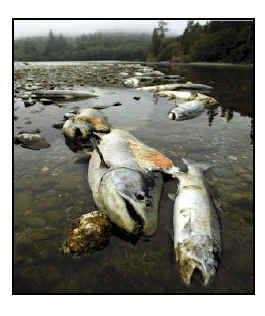 Dams go hand in hand with water
privatization. At a recent World Water Forum, a report from International Rivers Network served as
a briefing kit. From its section on dams, a famous case from the Pacific
Northwest provided background on an infamous event that is expressed best by
this scene as photographed here. Thousands of adult salmon
were killed when
Klamath River water was returned to farmers in fall 2002 by the federal
government which knowingly violated environmental laws concerning the river and
its species. The Klamath flows from Oregon through the northern extremity
of California. Several Indian tribes lost their historic food supply, but
not much fuss was made commensurate with the crime. (Photo courtesy
of Defenders of Wildlife.)
Dams go hand in hand with water
privatization. At a recent World Water Forum, a report from International Rivers Network served as
a briefing kit. From its section on dams, a famous case from the Pacific
Northwest provided background on an infamous event that is expressed best by
this scene as photographed here. Thousands of adult salmon
were killed when
Klamath River water was returned to farmers in fall 2002 by the federal
government which knowingly violated environmental laws concerning the river and
its species. The Klamath flows from Oregon through the northern extremity
of California. Several Indian tribes lost their historic food supply, but
not much fuss was made commensurate with the crime. (Photo courtesy
of Defenders of Wildlife.)
Global perspective/background
Susan Bryce's indispensable article for the Australian Freedom & Survival Guide
(excerpt; see links at bottom) stated:
International discussions about the world's water supplies began in 1977 when the United Nations held the first World Water Conference in Mar del Plata, Argentina. The Conference declared the 1980s to be the "UN International Drinking Water Supply and Sanitation Decade." The altruistic goal was to ensure all people in the world had access to adequate water supplies and sanitation within a decade. Ten years later, the Brundtland Commission told the world that our approach to development was unsustainable but it had little to say about water. Then, in 1992, the Rio Conference on Environment and Development, in its "Agenda for the 21st Century" (known as "Agenda 21"), addressed fresh water in chapter 18 of its report.
In 1996, the World Water Council, a private think-tank, was formed. The founding members were Egypt's Ministry of Public Works and Water Resources, the Canadian International Development Agency and the French transnational water corporation Suez Lyonnaise des Eaux. Other organisations supporting the start-up of the World Water Council were:
* International Commission on Irrigation and Drainage
* International Water Resources Association
* Istituto Agronomico Mediterraneo
* International Water Association
* United Nations Children's Fund
* United Nations Development Program
* United Nations Educational Scientific and Cultural Organization
* United Nations Environment Program
* United Nations Food and Agriculture Organization
* Water Supply and Sanitation Collaborative Council
* World Bank
* World Conservation Union
* World Health Organization
* World Meteorological Association
The World Water Council set about developing The Long Term Vision for Water, Life and Environment, better known by its subtitle, World Water Vision. To turn the World Water Vision into reality, the membership of the World Water Commission, as it became known, began to read like a who's who of the ruling elite. The high profile commissioners include:
* Dr Ismali Serageldin (Commission Chair), Vice President, World Bank, and Chair of Global Water Partnership
* Margaret Catley-Carlson, President, Population Council
* Gordon Conway, President, The Rockefeller Foundation
* Mohamed T. El-Ashry, Chair and CEO of the Global Environment Facility
* Howard Hjort, former Deputy Director, FAO
* Enriquo Iglesias, President, Inter-American Development Bank
* Yolanda Kababadse, President, World Conservation Union
* Jessica Mathews, President, Carnegie Endowment for International Peace, USA
* Robert S. McNamara, Co-Chair, Global Coalition for Africa
* Maurice Strong, Chair, Earth Council, member of Commission on Global Governance, and a chief adviser in charge of the UN reform process
* Wilfred Thalwitz, former Senior VP, World Bank
* Jerome Mondo, Chair of the Supervisory Board, Suez Lyonnaise des Eaux
An international network of citizens groups opposed global water privatization plans at the third World Water Forum in Japan in March 2003. Groups used the conference to advocate an alternate vision for resolving global water crisis. One of the tactics of the corporate agenda of the water interests is to call privatization something else: A policy writer for the World Water Council gave the meeting its script; while claiming to be independent, "the WWC supports the public-private partnership approach to water supply, which is a euphemism for privatization. Local accountability and control are often lost in privatization plans." - Blue Planet Project, which calls for the launch of an international campaign to keep water as part of the global commons.
Conclusion
What are we dealing with? One of the top three water corporations is Vivendi Environment which employs 295,000 people and "earned" $12 billion in 2002. The implications of these companies' activities, enforced by the World Bank's requirement of conversion of public systems to private as a condition for loans, include higher prices for water, cut-offs to customers who cannot pay, reduced water quality, and political corruption.
What did Mohandas Gandhi say about exploitation, centralization, and industrialization?
"Centralization as a system is inconsistent with a nonviolent structure of society... the mania for mass production is responsible for the world crisis... if there is production and distribution both in the respective areas where things are required, it is automatically regulated, and there is less chance for fraud, none for speculation.
"I don't believe that industrialization is necessary in any case for any country... it is machinery that has enabled these nations to exploit others... What is the cause of the present chaos? It is exploitation." - Mohandas Gandhi
A cultural revolution and its nonviolent methods stands for equitable access to resources, non-exploitation of humanity, and the right of nature to exist with intrinsic value. To get there, non-cooperation with oppressive governments, corporations, and persons must be combined with compassion for prevailing ignorance and fear. You are just about ready to act in concert to do your part.
A local note with a strong message
The Mad River, flowing from Trinity through Humboldt Counties in northern
California, was almost going to have its relatively clean water regularly barged down to
the southern tip of the state in giant petroleum bags. The citizens of Arcata in
Humboldt overwhelmingly attacked the idea at a city council hearing and defeated
the scheme. Some pointed out the risk of allowing a global trade tribunal
to get jurisdiction over the water if the locals wanted to sever the deal.
The
company wanting to sell the water in this fashion was called Aqueous. Civil
rights activist Spring Lundberg objected to the scheme and told the council
members "not to acquiesce to Aqueous."
*****
References and recommendations:
- A new Gandhian movement is explored in a
prior Culture Change Letter, #42
- Transnational
Institute and water justice
- Corporate
Europe Observatory (CEO)
- International
Rivers Network briefing kit
- Recent water privatization articles are in Resurgence
magazine's July-August issue, available through the Resurgence
website.
- Jim Hightower on Bolivia
says No to Globaloney
- Susan
Bryce's history article from Nexus Magazine
- Waterways are a source of drinking water, and are being attacked and
defended. See WaterKeeper
Alliance.
- yellowtimes.org
regarding African water privatization
- Michigan stops Nestle's
spring water exploitation
- Global Warming Crisis Council
- Overpopulation:
Resources for Understanding and Taking Action
Back to Home Page
Jan Lundberg's columns are protected by copyright; however, non-commercial use of the material is permitted as long as full attribution is given with a link to this website, and he is informed of the re-publishing: info@culturechange.org
|
