Home
|
by David West
|
 A message to Americans - STOP PURSUING! A message to Americans - STOP PURSUING!
Opinions on the benefits or detriments of marijuana are very mixed, so it would seem that we should listen to those with most factual experience.
Several members of the BTI Institute are participating in daily experiments, and they are reporting amazing success. |
|
|
by Jan Lundberg
|
 A sail transport revival is afoot and afloat around the world. As the cheap, easy crude oil has mostly been extracted from the Earth and spewed into the sky and water, the desirability and economics of sail power get stronger. A sail transport revival is afoot and afloat around the world. As the cheap, easy crude oil has mostly been extracted from the Earth and spewed into the sky and water, the desirability and economics of sail power get stronger.
Sail Transport Network (STN) is an open project for almost anyone to participate in. Most of the inhabited world is coastal or on rivers. STN was put forward originally by Culture Change in 1999. We sail-transport activists envision linking coastal communities, islands, and river communities together sustainably -- |
|
|
by Jan Lundberg
|
|
Why should people take action to improve society and the ecosystem, if collapse is imminent? Apart from ameliorating our present worsening conditions a tad (which is better than nothing), activism is vital for (a) practicing resistance and refusing bad deals, (b) creating models of sustainability through honing our skills and establishing long lasting projects and communities, and (c) maintaining both the traditional and newly established projects and communities, which will evolve rapidly through vigilance, trial and error, and above all, cooperation. |
|
|
by Jan Lundberg
|
Editor's note: A popular online news service asked for a follow-up article to my recent "Social Justice Activists Must Take Into Account Ecological, Cultural, and Economic Transformation." I was asked, "What it's like to live outside the system today -- how does this really look?" Piquing their interest was my ending paragraph:
The alternative to the faltering "$ociety," the love tribe, has been practiced long before the hippies began the Back to the Land movement at People's Park, Berkeley, in 1969. |
|
|
by Jan Lundberg
|
|
"Governors Resolve to Build Bridge" - Portland Tribune, April 28, 2011.
It would be hard to live anywhere in the United Paved Precincts of America (a.k.a. the USA) if responsible leadership and environmental protection were top considerations, because one would be thoroughly disappointed. So I will not overemphasize my disappointment over the new Interstate 5 freeway bridge over the Columbia River. It is planned for profitable and grandiose dreams rather than efficiency, safety, environmental considerations, and community health. Nothing new with that!
|
|
|
by Beilei Jin, Shanghai Oriental Morning Post
|

Posted on May 6, 2011
High oil prices and new international political and economic philosophy
In Jan Lundberg's interview with Oriental Morning Post - Weekly Edition, he told this reporter that petrocollapse is a global challenge and the next oil shock is just a matter of time. People need to be aware of this and start to live a simple, energy-wise and localized life before it's too late.
|
|
|
by Jan Lundberg
|
|
When the Titanic is in view of the giant iceberg, is it the moment to start reforming shipping practices? When Fukushima has blown, is it time to ponder how to better power the industrial economy? Is it not instead imperative in both cases to reverse course or sharply turn away? Clearly, we need to keep our eye on the ball, and keep from being distracted by fear tactics: headlines about Qadhafi, bin Laden and the next boogeyman. |
|
|
by Jan Lundberg
|
|
Popular protest against rulers in many parts of Africa and Asia has spread faster than most anyone would have dared hope. Ferment in other countries may well materialize and mount, including the U.S. However, while the recent uprisings have potential and are well stoked by rampant oppression and greed, we are no longer in a 19th or 20th century set of social or ecological conditions. The attainment of peace and prosperity can no longer be fully addressed with revolutions or social movements. The decades of economic growth from cheap oil -- producing wealth for some, not bringing peace -- cannot be replicated. |
|
|
by Jan Lundberg
|
 We are in the presence of death when we see so many signs that our species' modern behavior is shockingly deficient in living up to our responsibility to protect life. The ongoing Fukushima disaster, visiting upon us all, is the supreme example, on top of deforestation and fossil foolery (e.g., coal burning and plastics proliferation). They all rage on as we vainly try to muddle through individualistically. We are in the presence of death when we see so many signs that our species' modern behavior is shockingly deficient in living up to our responsibility to protect life. The ongoing Fukushima disaster, visiting upon us all, is the supreme example, on top of deforestation and fossil foolery (e.g., coal burning and plastics proliferation). They all rage on as we vainly try to muddle through individualistically.
In the Masque of the Red Death, by Edgar Allan Poe, Death himself walks freely among the revelers of the masque ball held by Prince Prospero. |
|
|
by Jan Lundberg
|
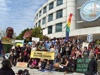 The revived anti-nuclear movement has promise, for the people coming together to volunteer and take on tasks are experienced. Those who are not veterans of the 1980s protests are dedicated and energetic. They're all ready for a fight to the finish: victory over allowing more Fukushimas, Chernobyls and Three Mile Islands. The revived anti-nuclear movement has promise, for the people coming together to volunteer and take on tasks are experienced. Those who are not veterans of the 1980s protests are dedicated and energetic. They're all ready for a fight to the finish: victory over allowing more Fukushimas, Chernobyls and Three Mile Islands.
On April 14 in San Francisco, California, the electric-rate state agency that in effect allows nuclear power's operation got an earful from the public. |
|
|
by Jan Lundberg
|
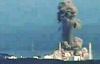 Note: see protest flier at bottom. Note: see protest flier at bottom.
As we plod along daily in this time of great change, we activists for the Earth often feel paradoxically that nothing is changing. More and more of us fear the clock is ticking faster and faster toward extinction. At the same time there are clear signs we should soon expect a better way of living in balance with the Earth to come about fairly soon.
|
|
|
by "Ben Loman"
|
|
Editor's note: Added radioactivity in our environment from the General Electric-designed Fukushima poison-spewing death complex is on top of other man-made poisons assaulting our bodies. We are too slowly learning we cannot tolerate them. We need to wake up to the scams done not for us but to us. Healing ourselves and the planet go together, but some would rather get rich at others' expense. Just as nuclear power was falsely claimed to be "needed" and "for peace," our author reveals how the swine flu phenomenon was "the artificial recategorization of cases of regular flu that exist all over the world for the purpose of marketing and selling a vaccine." - JL |
|
| << Start < Prev 11 . 12 . 13 . 14 . 15 . 16 . 17 . 18 . 19 . 20 . Next > End >>
|
|
|
|




