Home
|
by Jan Lundberg
|
Introduction
I was thinking about a friend who got a decent job recently. In the minds of billions of people, it would seem to solve his problems for meeting his obligations. Though entry level, it’s a desirable job where the workplace is pleasant. I began to reflect on his being a proud member of the working class, and how his path (however reluctant or exhilarating) generally follows middle class aspiration. It is extremely unlikely that someone in his position manages to join the exalted, glitzy, rich, tiny segment of the population, to enjoy the dream of the very easy life -- not that his value-system pushes him in that questionable direction.
Unfortunately, he is probably boxed in at the lower middle of the social pyramid, because another, very different path for working people and even the rich is not so visible or tempting. |
|
|
by Jan Lundberg
|
|
Review with author interview

Ikaria Island: Explore and Experience
A Travel and Walking Guide with Maps
by Charlene Caprio and Lefteris Tsouris
2015, Wooden Hull Press, USA
If exploring natural environments and traditional cultures are up your alley, this book is for you. You will feel like thanking two energetic young people who, with sensibility – not just the pull of adventure or business – made the effort to reveal and honor a unique, small part of the world. |
|
|
by Allan Stromfeldt Christensen
|
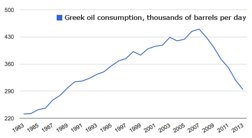
Over the past couple of months the story keeping many people on the edge of their seats has been the ongoing dilemma of Greece's detested debt burden, its Great Depression-worthy 25% contraction of its economy, and its voluntary or even forced withdrawal from the eurozone – the fabled "Grexit."
For about five years now, heavy austerity policies (cutbacks in government spending) have contributed to what is being described by some as a "humanitarian crisis." |
|
|
by Jan Lundberg
|
|
Urban dwellers experience a familiar hum caused mainly by motor vehicles, along with other sounds of modern civilization: buildings' heating and air conditioning, power tools, aircraft, and, arguably least objectionable, the voices of people and animals. Other urban background cannot be heard but is seen, smelled and, to some, felt: air pollution and electronic waves. The often murky air along with light-pollution assures that seeing many stars is unlikely, and is of little concern anyway to the typical technological urbanite.
This background is almost unnoticeable to those inured to it, such that it is only upon leaving and coming back that one perceives the discolor of the sky and the lack of silence in the city and suburbs.
|
|
|
by Jan Lundberg
|
Conflict, Contest, and Hope
In this time of serial, overlapping wars, accelerating climate destruction, and -- the epitome of inequity -- just 85 of the world's richest people's owning as much as what 3.5 billion people own, the dominant culture has overreached. It may find itself on the run as "the system" is opposed by a swelling majority of people. For we are suffering more and more, and we sense there are fundamental problems coming to a head. The common denominator is often oil.
It is well known that oil is involved in most of the Middle Eastern, Central Asian and African armed conflicts which involve oil-dependent societies (primarily the U.S.). War itself has been for the last century a massive oil operation, and the Pentagon is decade after decade the largest oil buyer in the world. |
|
|
by Jan Lundberg
|
 "Screenism" -- it is pervasive except among the very, very young, the very old, and the nature-dwelling primitive. It began with television over one half century ago, for those who had time for hours of passive entertainment. It was also for the electronically babysat, and still is. Except, now hand-held mobile telephones, "tablets," laptop and desktop computers are "essential," and billions of the most active people on the planet depend on them as well as upon digital technology in general. Everyone but a Rip van Winkle knows that far more kinds of imagery than TV, along with maximized communicating and information manipulation, have taken over society and lifestyles.
|
|
|
by V.I. Postnikov
|
|
I have had a long presentiment about Ukraine being the black hole for humanity. Probably it first was felt after the Chernobyl disaster. (Chernobyl translates into English as "a Black True Story” and "Wormwood.") Lately, my presentiment has only been strengthened.
The black hole has literally been dug by humans themselves. To explain this, let me turn to more history.
Ukraine historically is the land where nature accumulated one of the richest deposits of coal and ores, and some of the most fertile soil on earth. This fact lies at the root of the contradiction between the pastoral nature of Ukrainians and the industrial development imposed on them first by the Russian Empire, and then by the Soviets. The riches of the land had already been squandered by the end of the 20th century.
|
|
|
by Allan Stromfeldt Christensen
|
 Has fracking reached its twilight? Has fracking reached its twilight?
I'll admit that I was completely caught off guard by the recent (and ongoing?) crash in oil prices. It'd be a stretch to say I'm embarrassed by my lack of foresight, although perhaps "dumb-ass" would be a bit deserving.
I would say I'm well enough versed with the reality of peak oil: I've read perhaps a couple dozen books on the topic, pored through several of the peak oil blogs (upon deciding to end my 5-year Internet hiatus a year ago), have seen several talks given by various writers on the topic, and I've attended two Age of Limits conferences. |
|
|
by Vermonters for Sustainable Population and Jan Lundberg
|
|
Just as "sustainable growth" is ultimately an oxymoron, and just as the original 1970 Earth Day eventually became a co-opted, farcical Chamber of Commerce insult, the word "sustainable" has been nearly exhausted as a credible claim or slogan. But the concept remains and says a bit more than "green," because one then tends to reckon with population size. Sustainability is perhaps best defined as what is appropriate for a "seventh generation," the Native American philosophy. Yet, "sustainability" specialists, many of them well-meaning environmentalists, persist in reinventing sustainability criteria with nary a mention of the only record of sustainability: indigenous, traditional ways sustained for uncounted millennia. Culture Change welcomed this submission: |
|
|
by turn21
|
 This is the time for our species to “turn 21”: to transition from adolescence to responsible adulthood as citizens of the planet, before we destroy our own future. This is the time for our species to “turn 21”: to transition from adolescence to responsible adulthood as citizens of the planet, before we destroy our own future.
turn21.org asks only two things of you who are reading this: that you take the time to understand the human predicament as presented below, and that on the 21st of every month from now on you make some effort to spread this understanding to one or more other people.
|
|
|
by Jan Lundberg
|
 Under Captain Arjen van der Veen, the engineless 32-meter schooner brig Tres Hombres is arriving now in La Palma, Canary Islands. This is her sixth annual voyage across the Atlantic and back to Europe, carrying intensely desirable cargoes for discerning eco-savvy customers.
The tall ship started her voyage from her home port of Den Helder on Oct. 9. She first sailed to Stavanger, Norway to pick up a load of salt fish. From there she sailed to Brixham, UK, where she took on ale. Foul weather did not slow the ride; it made it faster. |
|
|
by Jan Lundberg
|
 A Tale of Three Studies • Oil Grows in Instability and Danger As It Goes Away Geologically • Cars Are Renewable? A Tale of Three Studies • Oil Grows in Instability and Danger As It Goes Away Geologically • Cars Are Renewable?
It was the summer that Al Gore had NASA's James Hansen testify in the Senate that human-caused global warming had begun: in August 1988 I founded Fossil Fuels Policy Action, a nonprofit institute, in Washington. We would be a clearing house for energy data & policy, with an eye to replacing fossil energy with renewable energy. Two all-consuming questions became our focus: why is the U.S. not conserving energy, and what can make it happen? This immediately morphed us from more passive "assessment" to more active advocacy, within our basic mission.
|
|
| << Start < Prev 1 . 2 . 3 . 4 . 5 . 6 . 7 . 8 . 9 . 10 . Next > End >>
|
|
|
|




